
Project Based Learning (PBL)
Title-1
Title-2
Title-3
Title-4
Project-Based Learning (PBL) · Renzulli Learning
Renzulli Learning Project-Based Learning: Empower K-12 Students Through Real-World Projects That Build Durable Skills
Project-Based Learning transforms how students learn — fostering deep understanding, critical thinking, and the durable skills employers and colleges demand. Renzulli Learning’s patented PBL module supports student-driven or teacher-assigned projects for individuals or groups — making it easy for teachers to find project resources or use their own, assign them to students, monitor and manage progress, and showcase finished work. All grounded in Dr. Joseph Renzulli and Dr. Sally Reis’s Enrichment Triad Type III research at the University of Connecticut.
Watch the demo
See Renzulli Learning’s PBL Module in Action
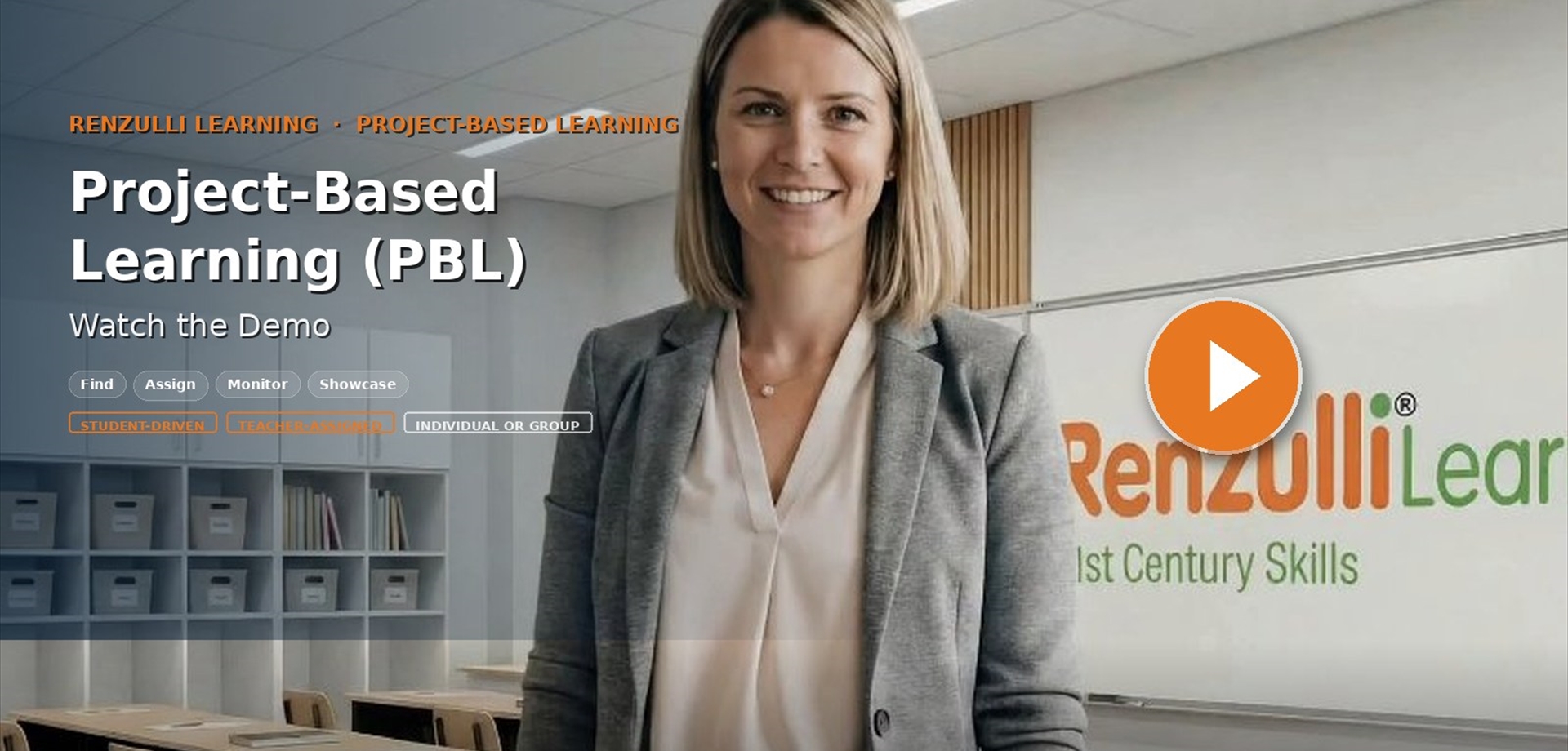
A demo of how Renzulli Learning’s PBL module helps teachers find project resources, assign them to students, monitor progress, and showcase finished work.
What Is Renzulli Learning’s Project-Based Learning Module?
Project-Based Learning (PBL) is a dynamic, strength-based approach that transforms how students learn, fostering deep understanding, critical thinking, and the durable skills that Portrait of a Graduate frameworks demand. Renzulli Learning’s patented platform is designed to make PBL accessible, engaging, and highly effective for every student, from Pre-K through 12th grade.
At Renzulli Learning, we believe students learn best when actively engaged and pursuing their passions. The Renzulli Profiler identifies each student’s interests, learning styles, and expression styles — and the PBL module uses that data to guide students to project resources and ideas they genuinely care about. With thousands of projects available in the system — from Super Starter Projects to Global Mini Projects to Pathways to Invention — plus the ability for students to turn any enrichment activity they’re exploring into a full project, Renzulli Learning is the only platform that supports the complete Type I → Type II → Type III Enrichment Triad pipeline: from exploration to skill development to creative productivity.
Seven Built-In Project Pathways
Renzulli Learning doesn’t just offer a blank canvas — it provides seven distinct project pathways, each designed for a different type of learning experience. With thousands of preloaded projects across every subject and grade level, students and teachers always have a starting point:
My Projects
The student’s personal project workspace. All active and completed projects live here — student-driven or teacher-assigned, individual or group.
Wizard Project Maker
A guided, step-by-step project builder. Teachers or students create custom projects from scratch — the Wizard walks them through goals, milestones, resources, and product options.
Super Starter Projects
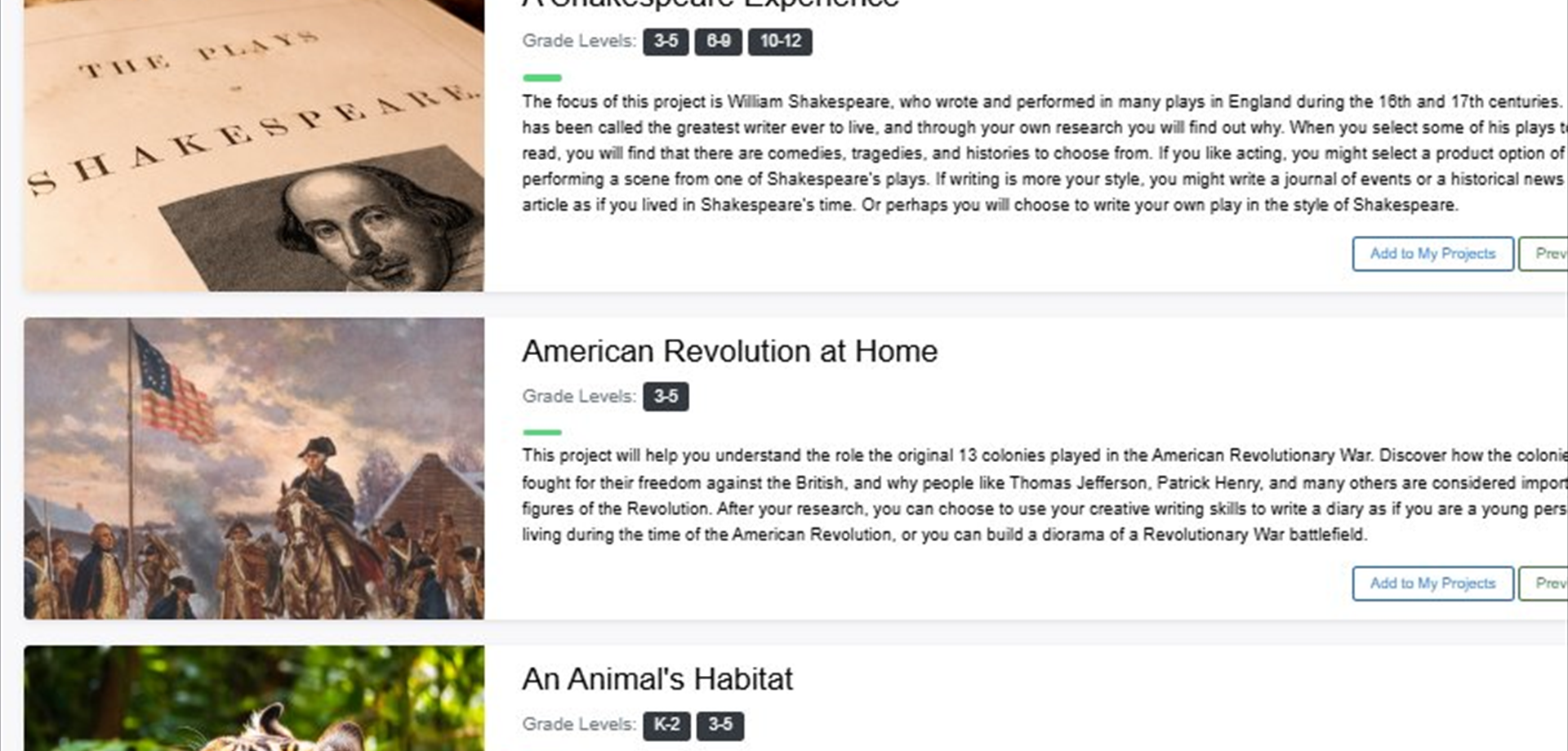
Preloaded, customizable projects that can be selected by students or assigned by teachers. Searchable by language, interest area, and grade level — from “A Shakespeare Experience” to “Acids and Bases.”
Global Mini Projects
Shorter, internationally-focused projects that build intercultural communication, empathy, and global awareness — perfect for a 1–2 week enrichment cycle.
Future Problem Solvers
Challenge-based projects where students tackle real-world problems of the future — building the critical thinking, creativity, and solution-design skills that define future-ready learners.
Pathways to Invention
Video-driven stories of real inventors and innovators — from tinkerers to entrepreneurs. Students explore the creative process, then apply what they learn to their own inventions.
Project Showcase
The publishing platform where students share finished work. Upload videos, images, and project documents to share externally in a secure environment. Used for virtual fairs, TPSP, GT showcases, and capstone exhibitions.
Four Project Templates — Every Grade, Every Purpose
When creating a new project, teachers and students choose from four purpose-built templates:
* All project templates can be highlighted in the Renzulli Learning Project Showcase module, which enables students to upload videos, images, or project documents to share their work externally in a secure environment. Thousands of projects are available in the system for students and teachers to utilize.
From Exploration to Creative Productivity: The Enrichment Triad Pipeline
| Enrichment Type | What Happens | How Renzulli Learning Supports It |
|---|---|---|
| Type I General Exploratory | Students are exposed to a wide variety of topics, disciplines, and fields they wouldn’t encounter in the regular curriculum. The goal is to spark interest — to find the topic that makes a student lean forward. | The Enrichment Database (40,000+ curated activities) and Renzulli Profiler match students to exploratory content based on their interests, learning styles, and expression styles. Students browse, explore, and discover what excites them. |
| Type II Group Training | Students develop thinking and research skills: creative problem-solving, critical thinking, communication, advanced reference skills, and methodology training in their area of interest. | Enrichment activities tagged for skill development, executive function coaching, and project templates that scaffold research methodology, data collection, and product creation — all connected to the student’s Profiler results. |
| Type III Creative Productivity | Students become first-hand inquirers — thinking, feeling, and doing like practicing professionals. They pursue self-selected problems, create original products, and present to real audiences. | The PBL module is the Type III engine: Wizard Project Maker, Super Starters, project milestones, teacher monitoring, and the Project Showcase where students publish finished work for peers, families, and the community. |
This is the pipeline that turns casual exploration into deep, meaningful, creative work. A student who discovers an interest in marine biology through a Type I enrichment activity can develop research skills through Type II training, and then design and execute an original investigation on local water quality as a Type III project — all within Renzulli Learning. No other platform connects exploration, skill development, and creative productivity in a single system.
How Renzulli Learning Makes PBL Easy — for Teachers and Students
Renzulli Learning supports two paths into Project-Based Learning: students can self-select investigations based on their Profiler interests, passions, and strengths, or teachers can assign projects to individuals or groups using the platform’s curated resources or their own materials. Either way, the platform handles the logistics so teachers can focus on guiding and inspiring:
Find
Assign
Monitor
Showcase
Whether the project is student-driven (a passion project sparked by the Profiler) or teacher-assigned (a curriculum-aligned investigation with clear deliverables), and whether it’s an individual deep-dive or a collaborative group effort, Renzulli Learning provides the structure, resources, and audience that make PBL meaningful.
What Are the Benefits of Project-Based Learning?
What PBL Develops in Students
Students analyze open-ended, real-world problems, evaluate evidence, iterate solutions, and present defensible conclusions — exactly the work that complements AI rather than competes with it.
Project menus and expression style matching give students the freedom to create original products — written, oral, visual, multimedia, performance, or service. Creativity can be assessed with the CTC and reinforced through project work.
Every project requires students to plan, organize, manage time, persist through challenges, and self-regulate — the exact EF skills the Renzulli Executive Function Assessment measures.
Group projects build teamwork and peer feedback skills. The Project Showcase requires students to present their work to a real audience — building the communication and leadership skills colleges and employers prize.
What PBL Provides for Students
What Is the Project Showcase?
The Project Showcase is a built-in feature of Renzulli Learning where students publish and present their completed PBL work. Other students, teachers, families, and community members can view the projects — creating a real audience that motivates higher-quality work and gives students practice communicating their ideas to others.
Districts have used the Project Showcase for virtual fairs, Texas Performance Standards Project (TPSP) presentations, capstone exhibitions, GT showcases, and school-wide celebrations of student work. It’s the final step in the Find → Assign → Monitor → Showcase workflow — and it’s where learning becomes visible.
“In order to keep our GT scholars engaged, Cedar Hill ISD decided to implement their GT Project Showcase on the Renzulli platform. We are excited to have a place for our scholars and families to share their work with other scholars and families and to share the wonderful innovative ideas they have regarding real-life situations. The scholars will upload their completed Texas Performance Standards Project (TPSP) into the Renzulli Type III Project Platform so that other scholars can login and see their work. This will be our very first virtual fair and we are excited about the outcome!”Natalie M. Garrett · District Coordinator of Advanced Academics, Cedar Hill ISD
How PBL Supports Your Portrait of a Graduate and Builds Durable Skills
PBL is one of the most direct ways to operationalize a Portrait of a Graduate framework. Every project requires students to practice the exact durable skills that portrait frameworks and employers demand:
| Portrait / Durable Skill | How PBL Builds It |
|---|---|
| Critical thinking | Students analyze open-ended problems, evaluate evidence, and iterate solutions — embedded in every project cycle. |
| Communication | The Project Showcase requires authentic presentation to a real audience — in writing, video, oral, or artistic product. |
| Collaboration | Group projects require teamwork, peer feedback, and shared problem-solving — collaboration as a practiced skill. |
| Creativity | Expression style matching and product menus give students the freedom to create original work aligned to their strengths. |
| Self-direction & agency | Students choose projects aligned to their interests, set milestones, manage their own progress, and reflect on outcomes. |
| Adaptability & persistence | Project milestones teach students to revise strategies when plans don’t work — Renzulli’s “task commitment” in action. |
The Project Showcase creates a documented portfolio of evidence that students, teachers, and families can reference for conferences, ECAP/ILP, and college applications — moving your Portrait of a Graduate from the wall to the classroom.
The Evidence Is Clear: PBL Significantly Boosts Student Achievement
USC Dornsife, Center for Economic and Social Research. In the first-ever study on PBL and Advanced Placement results, students taught AP US Government and AP Environmental Science with a PBL approach outperformed peers by 8 percentage points in year one of a randomized controlled trial, and were more likely to earn a passing score of 3 or above. In year two, PBL students outperformed by 10 percentage points. Read the research ›
Michigan State University (CREATE for STEM Institute). Third-grade students in PBL classrooms scored 8 percentage points higher on a state science test than students in traditional classrooms. The effects held regardless of reading level. Read the research ›
University of Michigan & Michigan State University. Second graders gained 5–6 months more learning in social studies and 2 months more in informational reading after PBL instruction. The students were from low-income backgrounds and underrepresented racial and ethnic groups — demonstrating PBL’s power to close equity gaps. Read the research ›
Stanford University. Sixth-grade students using a PBL science curriculum performed significantly better on state assessments in mathematics and English language arts. English language learners in PBL classrooms scored up to 28 percentage points higher on a language proficiency test. Read the research ›
“The evidence is clear — rigorous PBL results in a significant boost in academic achievement for students from many different backgrounds,” said Kristin De Vivo, Executive Director of Lucas Education Research. Source: Lucas Education Research / George Lucas Educational Foundation.
The Research Behind Renzulli Learning’s PBL Approach
Key Research Publications by Renzulli, Reis, and Colleagues
Renzulli, J. S. (1977). The Enrichment Triad Model: A guide for developing defensible programs for the gifted and talented. Mansfield Center, CT: Creative Learning Press. Learn about the Enrichment Triad ›
Introduces the three types of enrichment. Type III — the foundation of the PBL module — involves students who pursue self-selected areas as first-hand inquirers. Goals include planning, organization, resource utilization, time management, decision-making, self-evaluation, and developing authentic products directed at real audiences.
Reis, S. M. (1981). An analysis of the productivity of gifted students participating in programs using the Revolving Door Identification Model. University of Connecticut. View SEM research ›
Landmark finding: when a broader pool of students (15–20% of the general population) participated in Types I and II enrichment experiences, they produced Type III products of equal or higher quality than the traditionally identified top 3–5%. The research foundation for making PBL available to all students, not just those labeled “gifted.”
Starko, A. J. (1988). The effects of the Revolving Door Identification Model on creative productivity and self-efficacy. Gifted Child Quarterly, 32(3), 291–297. Read the paper ›
Documented that students who completed Type III products showed significant gains in creative self-efficacy — the belief that they can produce original, valuable work. This is exactly what the Project Showcase reinforces.
Baum, S. M., Renzulli, J. S., & Hébert, T. P. (1995, 1999). Reversing underachievement: Creative productivity as a systematic intervention. Gifted Child Quarterly, 39(4), 224–235. Read the paper ›
Research with 17 gifted underachieving students (ages 8–13) who completed Type III self-selected products based on their interests. 82% of students were no longer underachieving at the end of the intervention — demonstrating PBL’s power to re-engage even the most disengaged learners.
Olenchak, F. R., & Renzulli, J. S. (1989). The effectiveness of the Schoolwide Enrichment Model on selected aspects of elementary school change. Gifted Child Quarterly, 33(1), 36–46. Read the paper ›
Year-long study of 1,698 elementary students in 11 schools. Student creative products were numerous and exceeded the norm of typical student creative output. Positive changes were documented in both student and teacher attitudes toward learning.
Delcourt, M. A. B. (1993). Creative productivity among secondary school students: Combining energy, interest, and imagination. Gifted Child Quarterly, 37(1), 23–31. Read the paper ›
Documented that secondary students who completed Type III investigations demonstrated significant growth in creative productivity — combining the energy, interest, and imagination that define Renzulli’s Three-Ring Conception of Giftedness.
Reis, S. M., Renzulli, S. J., & Renzulli, J. S. (2021). Enrichment and gifted education pedagogy to develop talents, gifts, and creative productivity. Education Sciences, 11(10), 615. Read the paper ›
Open-access article identifying project-based learning as one of the key enrichment pedagogies that develops talents, gifts, and creative productivity — alongside interest-based learning, differentiation, open-ended choice, and the application of creative productivity to student learning.
Reis, S. M. (1981). Student Product Assessment Form (SPAF). Renzulli Center for Creativity, Gifted Education, and Talent Development, University of Connecticut. View instruments ›
The validated instrument for assessing the quality of Type III student products. Reliability coefficient of .96, with inter-rater agreement ranging from 86.4% to 100%. The SPAF criteria inform how the PBL module structures project evaluation and the Project Showcase assessment rubrics.
Renzulli Learning PBL: Common Questions
PBL Resources from Renzulli Learning & UConn
Start with the Roadmap, then explore the platform tools and Renzulli Center research that power Renzulli Learning’s PBL approach.
- Renzulli PBL At A Glance (PDF) — The complete guide for educators and administrators
- Start a Free 30-Day Trial — Try PBL with your students
- Lucas Education Research (George Lucas Educational Foundation) — Four landmark PBL studies from USC, MSU, U-M, Stanford
- SEM Research Studies (UConn) — Complete research summary
- Student Product Assessment Form (SPAF) — Evaluating Type III products
- Renzulli Center for Creativity, Gifted Education, and Talent Development at UConn
- Renzulli Learning Platform Overview
- Renzulli Learning Research — Evidence base for the platform
- Renzulli Learning Certified Educator Course — Professional development
Explore other Renzulli Learning assessments and tools:
Call +1 (203) 680-8301 · Email [email protected]