
Renzulli Executive Function Assessment
Title-1
Title-2
Title-3
Title-4
Executive Function Skills · Renzulli Learning
Renzulli Executive Function Assessment: Measure and Strengthen Working Memory, Cognitive Flexibility, and Inhibitory Control in K-12 Students
Brain-based executive function (EF) skills predict student success in learning, achievement, and life, often more than IQ or socioeconomic status. Built on Dr. Joseph Renzulli and Dr. Sally Reis’s research at the University of Connecticut, the Renzulli Executive Function Assessment lets students self-assess their EF skills and gives K-12 educators the inquiry-based activities, projects, and roadmap to strengthen them.
Watch the demo
See the Renzulli Executive Function Assessment in Action
A short demo of how the Renzulli Executive Function Assessment helps K–12 educators measure and strengthen working memory, cognitive flexibility, and inhibitory control.
Why Are Executive Function Skills So Important Right Now?
There is a growing crisis in student learning and well-being, intensified by technology, AI, disengagement, and mental health concerns. Educators, parents, and students report feeling overwhelmed and unprepared for a rapidly changing world. This isn’t a call for another isolated program but a unifying approach to develop student Executive Function (EF) skills.
There’s a “remarkable American consensus” among educators across political divides on the need for broader skills like communication, critical thinking, creativity, persistence, and collaboration, all closely linked to EF. This is a call to action from students who feel unready for life’s uncertainties, from early childhood educators grappling with challenging behaviors (as EF skills are foundational for learning and behavior regulation), and from employers who now prioritize skills like problem-solving and teamwork over grades.
The current focus on EF is grounded in brain science. Studies show that brain-based EF skills predict success in learning, achievement, health, and quality of life, often more so than IQ or socioeconomic status. Early childhood and adolescence are critical periods for forming and strengthening these skills due to high brain plasticity. Organizations like The School Superintendents Association (AASA) advocate for EF skills as “the glue and the foundation for our student and staff success,” emphasizing that these skills are crucial for navigating today’s complex world. The goal is not to add more to educators’ plates, but to integrate skill-building into everyday practices.
What Are the Three Executive Function Skill Areas?
Executive functions are a set of cognitive processes essential for success in the 21st century. The Renzulli Executive Function Assessment measures, and the Renzulli Learning enrichment platform develops, three interrelated skill domains:
Working Memory
Cognitive Flexibility
Inhibitory Control
These three skills underlie everything from academic achievement to mental health to workplace success. Renzulli Learning’s inquiry-based, interest-matched activities are research-proven to develop them in real instructional contexts, not as a separate program, but woven into the learning students are already doing.
How Renzulli Learning Helps You Measure and Strengthen Executive Functions
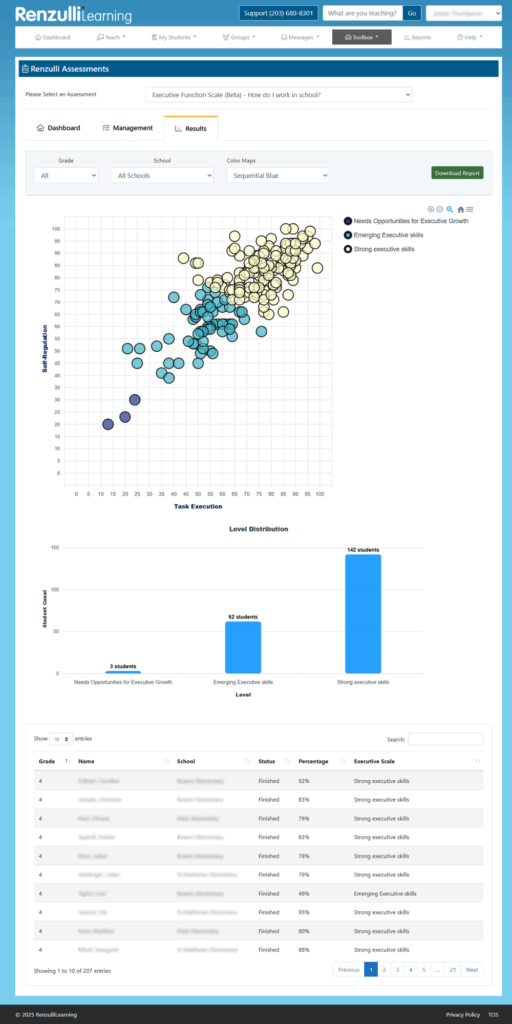
Renzulli Learning has expanded its platform to include the Renzulli Executive Function Assessment, enabling educators to assess students’ executive function abilities. The platform’s inquiry-based activities are research-proven to develop these critical skills.
What Are EF Skills Crucial For?
EF skills allow students to plan, organize, and execute complex tasks, the foundation of every meaningful academic challenge.
EF skills enable students to manage their time, set goals, and monitor their own progress, central to independent learning and PSP success.
EF skills help students navigate uncertainty and overcome challenges, the very capacities employers and colleges now prioritize.
EF skills support effective teamwork and interpersonal interactions, essential for group projects, leadership, and 21st-century work.
The Research Behind the Renzulli Executive Function Assessment
The Renzulli Learning platform is built on five decades of research by Dr. Joseph S. Renzulli, Board of Trustees Distinguished Professor and Emeritus Director of the Renzulli Center for Creativity, Gifted Education, and Talent Development at the University of Connecticut, and his collaborator and spouse Dr. Sally M. Reis, also a Board of Trustees Distinguished Professor at UConn’s Neag School of Education. Their work on the Schoolwide Enrichment Model (SEM), the Three-Ring Conception of Giftedness, and the role of executive functions in talent development directly informs the Renzulli Executive Function Assessment and the inquiry-based enrichment activities that build EF skills.
Key Research Publications by Renzulli, Reis, and Colleagues on Executive Functions
Reis, S. M., & Acar, S. (2026). Renzulli Learning Executive Function Assessment: Validity and Reliability. An independent psychometric study establishing the validity and reliability of the Renzulli Executive Function Assessment, conducted by Dr. Sally M. Reis (University of Connecticut) and Dr. Selcuk Acar (University of North Texas). Read the validity and reliability study (PDF) ›
Renzulli, J. S. (2021). Assessment for learning: The missing element for identifying high potential in low income and minority groups. Gifted Education International, 37(2). https://doi.org/10.1177/0261429421998304
Renzulli explicitly identifies executive function skills, alongside interests, instructional preference styles, and modes of expression, as the “soft skills” college admissions officers and employers now prioritize for leadership positions, and as a missing piece in equitable identification of high-potential students from underrepresented populations.
Taylor, C. L., Zaghi, A. E., Kaufman, J. C., Reis, S. M., & Renzulli, J. S. (2020). Characteristics of ADHD related to executive function: Differential predictions for creativity-related traits. Journal of Creative Behavior, 54(2), 350–362. https://doi.org/10.1002/jocb.370
A UConn research team including Reis and Renzulli examines how distinct components of executive functioning (activation, attention, effort, affect, memory) differentially predict divergent thinking, intellectual risk-taking, and creative self-efficacy, with major implications for twice-exceptional and ADHD-affected students.
Taylor, C. L., Zaghi, A. E., Kaufman, J. C., Reis, S. M., & Renzulli, J. S. (2020). Divergent thinking and academic performance of students with ADHD characteristics in engineering. Journal of Engineering Education, 109(2), 213–229. https://doi.org/10.1002/jee.20310
Demonstrates how executive function differences interact with academic performance in STEM fields, informing how the Renzulli Executive Function Assessment can surface strengths in students whose EF profile masks their creative potential in traditional classrooms.
Renzulli, J. S. (2012). Reexamining the role of gifted education and talent development for the 21st century: A four-part theoretical approach. Gifted Child Quarterly, 56(3), 150–159. Read the paper ›
Renzulli’s “Operation Houndstooth” framework positions executive functions as “leadership for a changing world”, the “yeast” that helps cognitive ability and creativity rise into achievement. Renzulli identifies five EF categories: action orientation, social interactions, altruistic leadership, realistic self-assessment, and awareness of the needs of others.
Reis, S. M., & Renzulli, J. S. (2020). The three-ring conception of giftedness and the Schoolwide Enrichment Model: A talent development approach for all students. In T. Cross & P. Olszewski-Kubilius (Eds.), Conceptual frameworks for giftedness and talent development (pp. 145–180). Prufrock Press. Read the chapter ›
Reis and Renzulli show that task commitment, the executional, EF-driven third ring of the model, is what turns above-average ability and creativity into actual gifted behaviors. Renzulli Learning’s SEM-based PBL framework is designed to develop precisely this capacity.
Reis, S. M., Renzulli, S. J., & Renzulli, J. S. (2021). Enrichment and gifted education pedagogy to develop talents, gifts, and creative productivity. Education Sciences, 11(10), 615. https://doi.org/10.3390/educsci11100615
Open-access article documenting how SEM-based enrichment pedagogy, the foundation of the Renzulli Learning platform, cultivates the executive function skills of planning, persistence, and self-regulation that turn potential into productive achievement.
Renzulli, J. S. All About Me: A Student Self-Assessment Scale of Executive Functions. Renzulli Center for Creativity, Gifted Education, and Talent Development, University of Connecticut.
Renzulli, J. S. Scale for Rating the Executive Functions of Young People. Renzulli Center for Creativity, Gifted Education, and Talent Development, University of Connecticut.
Two of Dr. Renzulli’s validated assessment instruments, available through the Renzulli Center at UConn, that form the foundation for the EF Assessment integrated into Renzulli Learning. View the full instruments list.
What Educators Are Telling Us About Executive Functions
Students feel unprepared
Students themselves report feeling unready for life’s uncertainties, from college to careers to navigating an AI-shaped world. EF is the through-line.
Behavior & regulation issues
Early childhood and elementary educators are grappling with challenging behaviors. EF skills are foundational for learning and behavior regulation, not an afterthought.
Employers want EF skills
Employers prioritize problem-solving, teamwork, persistence, and adaptability over grades, the exact skills EF underpins. Schools need to build them deliberately.
No more “one more program”
Educators don’t want another initiative on their plate. EF skill-building must be integrated into everyday instruction, which is exactly how Renzulli Learning is designed to deliver it.
What Renzulli Learning Provides for Executive Function Development
Each Renzulli Learning tool plays a specific, research-grounded role in measuring and developing executive function skills:
Why Assess Students’ Executive Functions, and Why Teach Them?
Brain science Renzulli & Reis (2020) SEM researchHow Renzulli Learning addresses the two questions every EF-focused educator faces:
| The Question | Renzulli Learning’s Answer |
|---|---|
| Why assess EF? How can educators support students in strengthening their executive functions when classroom time is already pressured? | The first step is understanding how students perceive their own abilities. The Renzulli EF Assessment, based on Dr. Renzulli’s validated UConn instruments, lets students reflect on self-regulation, focus, and adaptability, giving educators a concrete starting point and giving students metacognitive ownership of their growth. |
| Confidence gaps Some students feel confident in EF; others have untapped potential they don’t recognize. | The assessment surfaces both groups. Students who feel confident get opportunities to practice and stretch. Students who underestimate themselves get a structured way to reflect, set goals, and see growth over time. |
| Why teach EF? Research shows EF skills can be taught and improve with practice, but how do you do it without adding another program? | Renzulli’s 40,000+ enrichment activities and PBL investigations build EF skills through authentic learning, the exact mechanism documented in Reis & Renzulli’s Schoolwide Enrichment Model research. |
| Teacher modeling How can teachers model EF skills and make them concrete for students? | The Executive Function Roadmap gives teachers a step-by-step path for modeling organization and decision-making, providing structured support, and using Renzulli Learning to assign activities that showcase real-world applications of EF. |
| Independent & collaborative EF skills matter for both individual focus and group work. | Renzulli supports both: independent enrichment activities and PSP goal-setting build self-regulation; group projects and collaborative PBL investigations build the cognitive flexibility and communication EF underpins. |
| Twice-exceptional & ADHD EF differences are central to twice-exceptional and ADHD-affected students ’ experience. | Taylor, Reis, & Renzulli’s 2020 research shows that EF differences interact with creativity in nuanced ways. The EF Assessment helps surface 2E and ADHD students’ strengths so educators can match them with interest-driven enrichment that lets those strengths flourish. |
What EF Skill-Building Looks Like in Real Classrooms
“The Executive Function Assessment opened up a conversation we’d never had before. Students who I assumed were just ‘disorganized’ turned out to know exactly where they were struggling, they just didn’t have anyone asking them about it. Once they could name the skill, we could practice it together inside the projects they were already excited about.”Middle School Teacher · Renzulli Learning Certified Educator
Executive Functions: Common Questions
Executive Function Resources from Renzulli Learning & UConn
Start with the Roadmap, then explore the platform tools and Renzulli Center research that power Renzulli Learning’s approach to EF development.
- Renzulli Executive Function Roadmap (PDF), The complete guide for educators, coaches, and administrators
- Start a Free 30-Day Trial, Try the Renzulli EF Assessment with your students
- Renzulli Center for Creativity, Gifted Education, and Talent Development at UConn
- Dr. Joseph S. Renzulli’s complete publications list
- Dr. Renzulli’s validated student assessment instruments (UConn)
- Renzulli Learning Platform Overview
- Renzulli Profiler, Interest and learning style inventory
- Personal Success Plan (PSP), Goal-setting and progress tracking
- Renzulli Enrichment Database, 40,000+ inquiry-based activities
- Project-Based Learning (PBL), Authentic, EF-building investigations
- Renzulli Learning Research, Evidence base for the platform’s approach
- Renzulli Learning Certified Educator Course, Professional development
Explore other Renzulli Learning assessments and tools:
Research-Proven Results, Not Just Engagement
Independent, peer-reviewed studies of the Schoolwide Enrichment Model and Renzulli Learning show measurable gains for students:
Higher predicted future earnings for students in individualized enrichment built on Renzulli's model
University of Amsterdam · Booij, Haan & Plug (2016)
Creativity percentile gain after three years of Schoolwide Enrichment Model implementation
Italy SEM Study
Of underachieving students reversed underachievement through interest-based creative productivity
Baum, Renzulli & Hébert (1995)
Reading comprehension gains in a cluster-randomized study of Renzulli Learning across diverse schools
Field (2009), research on an earlier version
A Hands-On Learning Tool, Not Just a Digital One
Renzulli Learning is the spark, not the screen. The platform identifies each student's interests and gives them the springboard, the project tools, how-to resources, and the structure of real investigation, but the meaningful learning happens off the screen and out in the world.
Call +1 (203) 680-8301 · Email [email protected]