
Renzulli Profiler
Title-1
Title-2
Title-3
Title-4
The Renzulli Profiler · Renzulli Learning
The Renzulli Profiler: The Strength-Based Foundation for Personalized Learning and Durable Skills Development
Personalized learning starts with understanding each student’s strengths. Built on more than 40 years of research by Dr. Joseph Renzulli and Dr. Sally Reis at the University of Connecticut, the Renzulli Profiler captures each student’s unique combination of interests, learning styles, and expression styles — the strength-based data foundation that powers every other tool in the Renzulli Learning platform. The Profiler is the first step in assessing and developing the durable skills that Portrait of a Graduate frameworks demand.
What Is the Renzulli Profiler?
Differentiation and personalization start with understanding students’ interests, likes and dislikes, communication preferences, and learning styles. By matching students with customized learning opportunities that appeal to them individually, they become more engaged, learn more deeply, and stay more motivated.
With over 40 years of research backing it and used globally, the Renzulli Profiler reveals each student’s unique “profile” through brief, age-appropriate questions about their interests and preferred ways of communicating, learning, and expressing what they have learned. Students log into Renzulli Learning, complete the Profiler in 20–30 minutes, and receive a comprehensive digital snapshot that the Renzulli Learning platform then uses to recommend personalized enrichment activities, projects, and learning opportunities for grades Pre-K through 12.
Watch the demo
See the Renzulli Profiler in Action
A short demo of how the Renzulli Profiler captures student interests, learning styles, and expression styles — powering personalized enrichment across the Renzulli Learning platform.
What Does the Renzulli Profiler Measure?
The Renzulli Profiler captures three interlocking dimensions of each student. Together, they form a complete learner profile that powers personalized recommendations across the entire Renzulli Learning platform:
Interests
Learning Styles
Expression Styles
Each dimension is informed by decades of validated research. As Renzulli has written, “True differentiation requires that we look at all the characteristics of the learner in addition to achievement level.” The Profiler is what makes that possible at scale.
Why Differentiation, Personalization, and Engagement Start with the Profiler
Without a profile, differentiation is guesswork. Teachers can group students by reading level, by test score, or by behavior — but those proxies don’t reveal what actually motivates each child to learn. The Renzulli Profiler gives teachers the underlying data they need to match content, process, and product to the individual learner. Three things change once a student has a profile in the system:
What the Profiler Unlocks
Teachers stop guessing. Renzulli Learning’s 40,000+ enrichment activities are filtered and recommended based on each student’s actual profile data — not assumptions.
One teacher can deliver genuinely personalized enrichment to 30 students at once, because the platform — not the teacher — does the matching.
Students engage more deeply with work matched to their interests and styles. Engagement, in turn, is the gateway to deeper learning, persistence, and higher achievement.
The Profiler surfaces strengths in students whose academic test scores may not yet reflect their potential — particularly important for ELLs, low-SES, and historically underrepresented learners.
Available in 20+ Languages — Translate Profile Results with One Click
As classrooms become increasingly multilingual, educators are challenged to understand students whose home language differs from the school’s language of instruction. The Global Profiler solves this: students take the Renzulli Profiler in their native language, and teachers see the results in their school’s language of instruction. With more than 20 supported languages, it’s an immediate, scalable solution for increasing engagement among English language learners and multilingual learners worldwide.
What an English Profiler Report Looks Like
Below is a sample of the report teachers receive when a student completes the Renzulli Profiler in English. Every personalized recommendation across the Renzulli Learning platform — from enrichment activities to PBL investigations to PSP goals — flows from this single report.
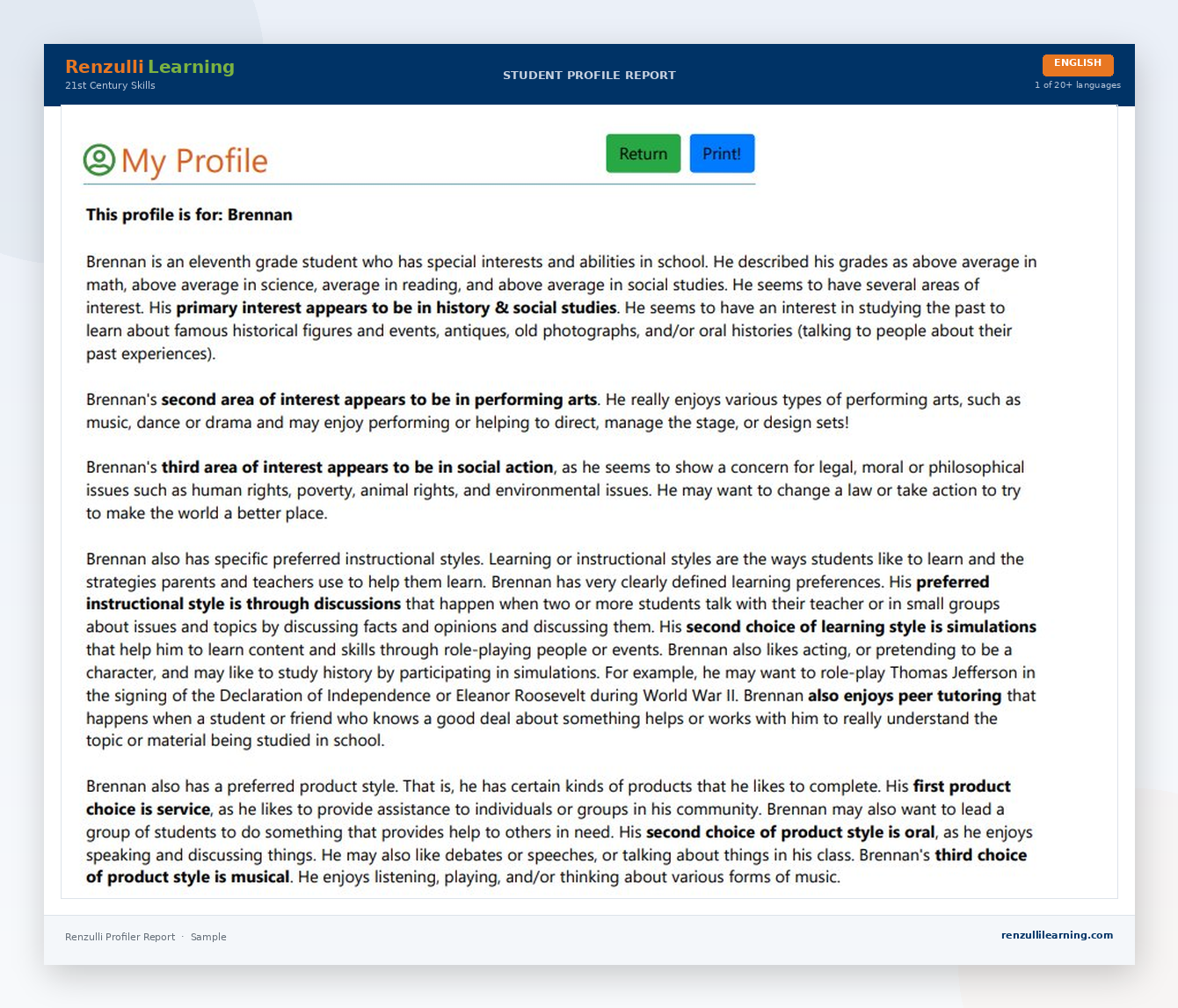
›› View the complete English Profiler report (PDF)
Featured Sample Reports in Six Languages
Click any language below to view a complete sample Profiler report. Reports are also available in 14+ additional languages inside the Renzulli Learning platform — contact us for the full language list.
The Foundational Research Behind the Renzulli Profiler
The Renzulli Profiler is the digital realization of a body of work Dr. Joseph Renzulli began in 1977 with the original Interest-A-Lyzer — one of the most widely cited interest assessment instruments in K-12 education. Over the next five decades, Renzulli, Dr. Sally Reis, and their colleagues at the University of Connecticut developed a complete family of validated instruments capturing the three dimensions students bring to learning: interests, learning style preferences, and expression style preferences. The Renzulli Profiler integrates all three into a single digital tool inside the Renzulli Learning platform.
Foundational Instruments by Renzulli, Reis, and Colleagues
Renzulli, J. S. (1977). The Interest-A-Lyzer. Mansfield Center, CT: Creative Learning Press.
Renzulli, J. S., & Smith, L. H. (1978). The Learning Styles Inventory: A Measure of Student Preference for Instructional Techniques. Mansfield Center, CT: Creative Learning Press.
The original Learning Styles Inventory (LSI), developed at the University of Connecticut. Captures student preferences for nine instructional modes: lecture, discussion, drill and recitation, peer teaching, simulation, projects, teaching games, independent study, and programmed instruction. View the original LSI (PDF, UConn).
Renzulli, J. S., & Smith, L. H. (1984). Learning style preferences: A practical approach for classroom teachers. Theory Into Practice, 23(1), 44–50. Read the paper ›
The peer-reviewed framing of how the Learning Styles Inventory should be used for matching students with appropriate instructional approaches in the regular classroom — the conceptual foundation for what Renzulli Learning now does automatically through the Profiler.
Renzulli, J. S. (1997). Interest-A-Lyzer Family of Instruments: A Manual for Teachers. Waco, TX: Prufrock Press. View the Elementary Interest-A-Lyzer (PDF, UConn) ›
The complete grade-band family of interest assessment instruments — Primary Interest-A-Lyzer, Regular Interest-A-Lyzer, Secondary Interest-A-Lyzer, and the Reading Interest-A-Lyzer. All grade-band versions are integrated into the Renzulli Profiler and surface differently for Pre-K, elementary, middle, and high school students.
Kettle, K. E., Renzulli, J. S., & Rizza, M. G. Exploring student preferences for product development — My Way... An Expression Style Inventory. Renzulli Center for Creativity, Gifted Education, and Talent Development, University of Connecticut.
The validated expression style inventory that completes the Profiler. Captures student preferences for ten product types — written, oral, hands-on, artistic, audio/visual, computer-based, service, dramatization, manipulative, musical — aligned with the Schoolwide Enrichment Model’s emphasis on authentic student products. Read about the My Way inventory.
Renzulli, J. S. (2021). Assessment for learning: The missing element for identifying high potential in low income and minority groups. Gifted Education International, 37(2). https://doi.org/10.1177/0261429421998304
Renzulli explicitly identifies interests, instructional preference styles, and preferred modes of expression — the exact dimensions captured by the Profiler — as the missing elements in equitable identification of high-potential students from underrepresented populations. A landmark argument for why every K-12 student deserves a profile.
Independent Research Documenting Renzulli Learning Achievement Gains
Field, G. B. (2009). The effects of the use of Renzulli Learning on student achievement in reading comprehension, reading fluency, social studies, and science. International Journal of Emerging Technologies in Learning (iJET), 4(1), 29–39. https://doi.org/10.3991/ijet.v4i1.629
Cluster-randomized study of 383 grade 3–8 students in Georgia and California. After 16 weeks using Renzulli Learning for 2–3 hours per week, treatment students demonstrated significantly higher growth in reading comprehension (p < .001), oral reading fluency (p = .016), and social studies achievement (p = .013) than control classmates. Renzulli Learning earned a “Promising” rating from Evidence for ESSA.
Reis, S. M., McCoach, D. B., Little, C. A., Muller, L. M., & Kaniskan, R. B. (2011). The effects of differentiated instruction and enrichment pedagogy on reading achievement in five elementary schools. American Educational Research Journal, 48(2), 462–501. Read the paper ›
Sally Reis-led study published in the field’s top-tier journal documenting significant reading achievement gains when Renzulli/Reis differentiated enrichment pedagogy — the same approach delivered through Renzulli Learning — is implemented systematically in elementary schools.
How the Renzulli Profiler Powers the Renzulli Learning Platform
Renzulli (1977) Renzulli & Smith (1978) Renzulli (2021)The Profiler is the data foundation. Every other tool in Renzulli Learning gets smarter once a student completes it:
| Renzulli Learning Tool | How the Profiler Powers It |
|---|---|
| Enrichment Database 40,000+ inquiry-based, interest-matched activities | Activities are filtered and ranked for each student based on their Profiler interests, learning styles, and expression styles. Without the Profiler, the database is a library; with it, it’s a personalized recommendation engine. |
| Project-Based Learning (PBL) SEM Type 3 investigations | The Profiler surfaces the topics students genuinely care about — the indispensable starting point for SEM Type 3 investigations, where authentic, self-selected problems drive deep learning. |
| Personal Success Plan (PSP) Goal-setting and progress tracking | Students set goals tied to their interests and strengths. The PSP draws directly on Profiler data to generate personally meaningful goal categories rather than generic templates. |
| Executive Function Assessment Self-regulation, focus, adaptability | EF skills develop best inside work students care about. The Profiler ensures EF practice happens within personally engaging activities — not abstract drills. |
| Leadership Assessment Communication, teamwork, decision-making | Leadership develops through interest-driven projects. The Profiler matches students with leadership opportunities aligned to their genuine passions. |
| Cebeci Test of Creativity (CTC) Fluency, flexibility, originality, elaboration | The CTC measures creative ability; the Profiler ensures that creative ability is developed inside contexts the student finds personally engaging — the proven gateway to growth. |
What Educators Say About the Renzulli Profiler
“Renzulli Learning is the most original and practical resource for classroom differentiation I have seen. The student profiles and a wealth of material in the system make it much easier to challenge students in any curricular area.”Sandra N. Kaplan · Professor, University of Southern California
Renzulli Profiler: Common Questions
Renzulli Profiler Resources from Renzulli Learning & UConn
Sample Profiler reports in 6 featured languages are available in the Global Profiler section above. Below: foundational research, validated instruments from UConn, and a free trial to see the Profiler in action with your own students.
- Renzulli Profiler Roadmap (PDF) — The complete guide for educators, coaches, and administrators
- Start a Free 30-Day Trial — Try the Renzulli Profiler with your students
- Renzulli Learning Differentiation White Paper (Renzulli & Reis) — PDF
- Dr. Renzulli’s complete list of validated student assessment instruments (UConn)
- Renzulli Center for Creativity, Gifted Education, and Talent Development at UConn
- Renzulli Learning Research — Evidence base for the platform
Explore other Renzulli Learning assessments and tools:
Call +1 (203) 680-8301 · Email [email protected]