3 Tiers
Enriched Core · Targeted Enrichment · Advanced Acceleration
4
Proprietary assessments for data-based decisions
40,000+
Curated enrichment activities
Pre-K–12
All grade levels — continuous progress monitoring

A Strengths-Based, Data-Driven Platform for Every Tier
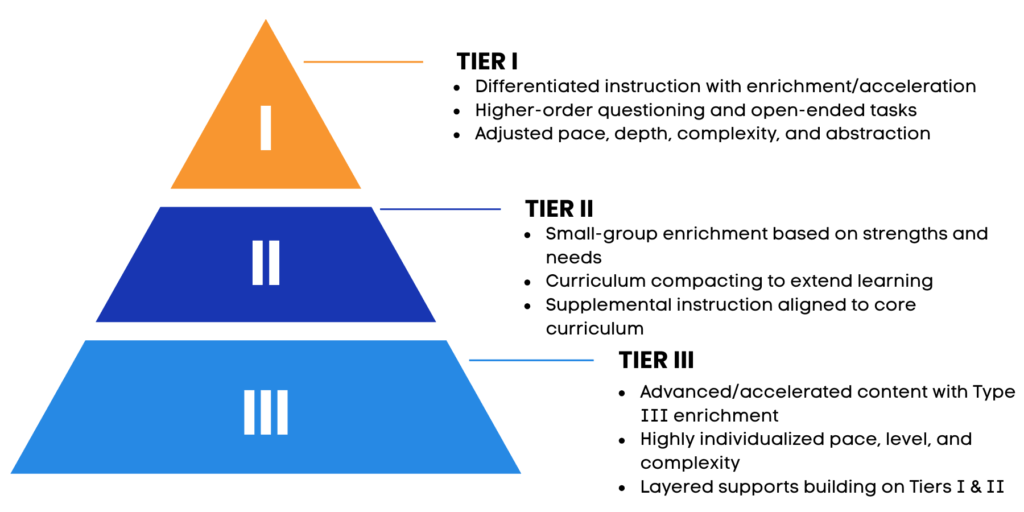
Quick answer Renzulli Learning aligns with Multi-Tiered Systems of Support (MTSS) to integrate data and instruction using a strength-based approach built on the Schoolwide Enrichment Model (SEM). Four proprietary assessments measure the durable skills that Portrait of a Graduate and career readiness frameworks demand. Educators use these valid, reliable assessments and continuous progress monitoring to make data-based decisions about enrichment, acceleration, and intervention across Tier 1, Tier 2, and Tier 3 — identifying students with high potential, creativity, and demonstrated talents while spotting students with specific needs.
Renzulli Learning MTSS Framework — Tier 1, Tier 2, Tier 3 integration with strengths-based enrichment and assessment
Identify students with high potential, creativity, and demonstrated talents — through the Renzulli Profiler, Executive Function Assessment, Leadership Assessment, and Cebeci Test of Creativity (CTC).
Provide evidence-based interventions and enrichment — 40,000+ curated, standards-aligned activities matched to each student’s profile, plus Project-Based Learning and curriculum compacting.
Monitor student progress and engagement — continuous data from assessments, project milestones, and Personal Success Plan goal cycles.
Adjust intensity and nature of supports — data-based decisions about moving students between tiers based on responsiveness to instruction.
Spot twice-exceptional (2e) students — the Profiler reveals strengths regardless of deficits; multiple assessments provide data points that identify students with both specific talents and specific needs.

Tiered Support Within MTSS: How Renzulli Learning Aligns

Tier What It Looks Like Renzulli Learning Tools
Tier 1
Enriched Core
Differentiate core instruction for all students through higher-order questioning, open-ended assignments, and adjustments to abstraction, complexity, pace, and depth. Systematic enrichment aligned with and extending the regular curriculum. Renzulli Profiler for personalization, 40,000+ enrichment activities matched to student profiles, differentiated search by subject and standard, teacher-uploaded resources.
Tier 2
Targeted Enrichment
Group students by strengths, interests, or needs — identified via assessments and observations — to deliver supplemental interventions such as curriculum compacting for clustered small groups. EF Assessment, Leadership Assessment, CTC for grouping data, collaborative enrichment clusters, PBL group projects, differentiated lessons.
Tier 3
Advanced Acceleration
Offer accelerated options and advanced content — often interest-based Type III enrichment — in addition to Tier 2 and Tier 1 supports. Instruction differs significantly in pace, level, complexity, and abstraction. Type III creative productivity via PBL (Wizard, Super Starters, Project Showcase), Personal Success Plan for goal-setting and portfolio documentation, independent study, curriculum compacting.

Assessments That Power MTSS Decision-Making

MTSS requires valid, reliable data to identify students, monitor progress, and adjust supports. Renzulli Learning provides four proprietary assessments purpose-built for these decisions:

Assess

Renzulli Profiler

Identifies interests, learning styles, and expression styles. Available in 20+ languages. The foundation for personalized enrichment matching and strengths-based identification.

Learn more ›

Assess

Executive Function Assessment

Measures planning, organization, attention, flexibility, self-regulation, working memory, and task initiation — the cognitive skills that underpin all academic performance.

Learn more ›

Assess

Leadership Assessment

Measures collaboration, communication, and leadership behaviors — identifying students who may not appear on traditional academic measures.

Learn more ›

Assess

Cebeci Test of Creativity (CTC)

Measures divergent thinking, originality, and creative potential. US Patent 12,087,176. Deployable in any language — identifies creative talent regardless of language or academic performance.

Learn more ›

Renzulli Learning as a Gifted Services Tool

Gifted support and enrichment teachers can use Renzulli Learning to deliver direct services within MTSS: assigning enriched and accelerated learning experiences connected to academic standards and based on student choice.

Enrichment activities and collaboration projects — 40,000+ curated options matched to Profiler data, plus teacher-uploaded materials.
Renzulli Learning Differentiated Lessons — pre-built, standards-aligned lessons differentiated by interest, learning style, and expression style.
Differentiated Search Engine by subject and standard — teachers find the right activity for the right student, aligned to the right standard, in seconds.
Curriculum compacting as a supplemental tool — eliminate content students have already mastered and replace it with enrichment or acceleration, documented through the platform.

Monitor, Adjust, and Document Student Growth

MTSS requires continuous monitoring to assess engagement, achievement, and performance; examine responsiveness to instruction; and evaluate the effectiveness of interventions. Renzulli Learning provides this data through:

Assessment data — Profiler results, EF scores, Leadership scores, and CTC creativity scores provide baseline and growth data for every student.
PBL milestones and checkpoints — project progress tracking with teacher feedback at each stage.
Personal Success Plan goal cycles — students Think, Dream, Plan, and Succeed in documented cycles that show growth over time.
Engagement and activity tracking — see which enrichment activities students are completing, how they’re engaging, and where they need more challenge or support.
Download the MTSS Integration Guide: A printable PDF guide for MTSS coordinators, GT specialists, and administrators showing how Renzulli Learning aligns with each tier of your MTSS framework. Download the guide (PDF) ›

Research by Renzulli, Reis, and Colleagues Supporting MTSS Integration

The Schoolwide Enrichment Model (SEM) — the foundation of Renzulli Learning — has over four decades of research documenting its effectiveness across all three tiers of support. Here are the key studies that support using Renzulli Learning within an MTSS framework:

Tier 1 · Reis, Renzulli & Renzulli (2021) Enrichment and gifted education pedagogy to develop talents, gifts, and creative productivity. Education Sciences, 11(10), 615. Documents how SEM-based enrichment pedagogy — the same approach delivered through Renzulli Learning — develops talents, creative productivity, and engagement for all students in the general classroom. Read the paper ›
Tier 1 · Field (2009) — University of Connecticut / University of Georgia The effects of the use of Renzulli Learning on student achievement. International Journal of Emerging Technologies in Learning (iJET), 4(1), 29–39. Cluster-randomized study of 383 students showing significant gains in reading comprehension (p<.001), fluency (p=.016), and social studies (p=.013) across diverse urban and suburban populations. Read the paper ›
Tier 2 · Reis, Westberg, Kulikowich & Purcell (1998) Curriculum compacting and achievement test scores: What does the research say? Gifted Child Quarterly, 42(2), 123–129. Found that students whose curriculum was compacted showed no loss in achievement — and the time freed was used for enrichment and acceleration. The research foundation for Tier 2 curriculum compacting within Renzulli Learning. Read the paper ›
Tier 3 · Baum, Renzulli & Hébert (1995) Reversing underachievement: Creative productivity as a systematic intervention. Gifted Child Quarterly, 39(4), 224–235. Research with 17 gifted underachieving students who completed Type III self-selected products. 82% of students were no longer underachieving at the end of the intervention — demonstrating the power of intensive, interest-based enrichment at Tier 3. Read the paper ›
Assessment · Renzulli (2021) Assessment for learning: The missing element for identifying high potential in low income and minority groups. Gifted Education International, 37(2). Renzulli argues that interests, instructional preference styles, modes of expression, and executive function skills are essential for equitable identification — the exact data Renzulli Learning’s four assessments provide for MTSS decision-making. Read the paper ›
Schoolwide · Olenchak & Renzulli (1989) The effectiveness of the Schoolwide Enrichment Model on selected aspects of elementary school change. Gifted Child Quarterly, 33(1), 36–46. Year-long study of 1,698 students in 11 schools. Student creative products exceeded norms and positive changes were documented in both student and teacher attitudes toward learning — the schoolwide impact MTSS coordinators need to see. Read the study ›
20-year summary · Reis & Renzulli (2003) Research related to the Schoolwide Enrichment Triad Model. Gifted Education International, 18(1), 15–40. Comprehensive summary of eight research components over 20 years — including creative productivity, underachievement reversal, self-efficacy gains, and longitudinal outcomes — across diverse populations and school settings. Read the paper ›

MTSS & Renzulli Learning: Common Questions

Renzulli Learning integrates with Multi-Tiered Systems of Support (MTSS) by providing strengths-based assessment, personalized enrichment, and continuous progress monitoring across all three tiers. Tier 1: differentiated core instruction with 40,000+ enrichment activities matched to student profiles. Tier 2: targeted enrichment through collaborative grouping, curriculum compacting, and supplemental interventions based on assessment data. Tier 3: advanced acceleration with interest-based Type III enrichment, accelerated content, and significantly differentiated instruction.
Four proprietary assessments: (1) Renzulli Profiler — interests, learning styles, and expression styles; (2) Executive Function Assessment — planning, organization, attention, flexibility, self-regulation, working memory, and task initiation; (3) Leadership Assessment — collaboration, communication, and leadership behaviors; (4) Cebeci Test of Creativity (CTC) — divergent thinking, originality, and creative potential (US Patent 12,087,176).
Gifted support and enrichment teachers can use Renzulli Learning to deliver direct services within MTSS: assigning enriched and accelerated learning experiences connected to academic standards and based on student choice. Tools include enrichment activities, collaboration projects, differentiated lessons, a differentiated search engine by subject and standard, and curriculum compacting.
Tier 1 (Enriched Core): Differentiate core instruction through higher-order questioning, open-ended assignments, and enrichment aligned with the regular curriculum — for all students. Tier 2 (Targeted Enrichment): Group students by strengths, interests, or needs using assessment data, then deliver supplemental interventions for clustered small groups. Tier 3 (Advanced Acceleration): Accelerated options and advanced content — often interest-based Type III enrichment — with instruction that differs significantly in pace, level, complexity, and abstraction.
The platform uses frequent formal and informal data to assess engagement, achievement, and performance; examine responsiveness to instruction; and evaluate the effectiveness of interventions. Built-in assessments, PBL milestones, and Personal Success Plan goal cycles provide continuous data appropriate to each student’s grade and skill level.
Yes. The Renzulli Profiler identifies each student’s strengths regardless of deficits — revealing talent that may be masked by a disability. The EF Assessment, Leadership Assessment, and CTC provide additional data points that help educators spot students with both specific talents and specific needs. This strengths-based, multi-assessment approach is ideal for identifying twice-exceptional (2e) students within an MTSS framework.

Call +1 (203) 680-8301  ·  Email [email protected]