
The Total Talent Portfolio
Title-1
Title-2
Title-3
Title-4

The Platform · Renzulli Learning
The Total Talent Portfolio: One Living Record of the Whole Student, Interests, Growing Durable Skills, and Best Work, In and Out of School
The Total Talent Portfolio is the student record at the heart of Renzulli Learning, and it is built for hands-on, student-driven learning. Much of the work it documents happens off-screen, in the real world: projects, clubs, sports, community service, and creative products. As districts work to limit screen time, Renzulli Learning helps replace passive screen minutes with active, authentic learning, then captures each student’s interests, growing durable skills, and best work in a populated, evidence-based Portrait of a Graduate profile.
One Portfolio That Reflects the Whole Student
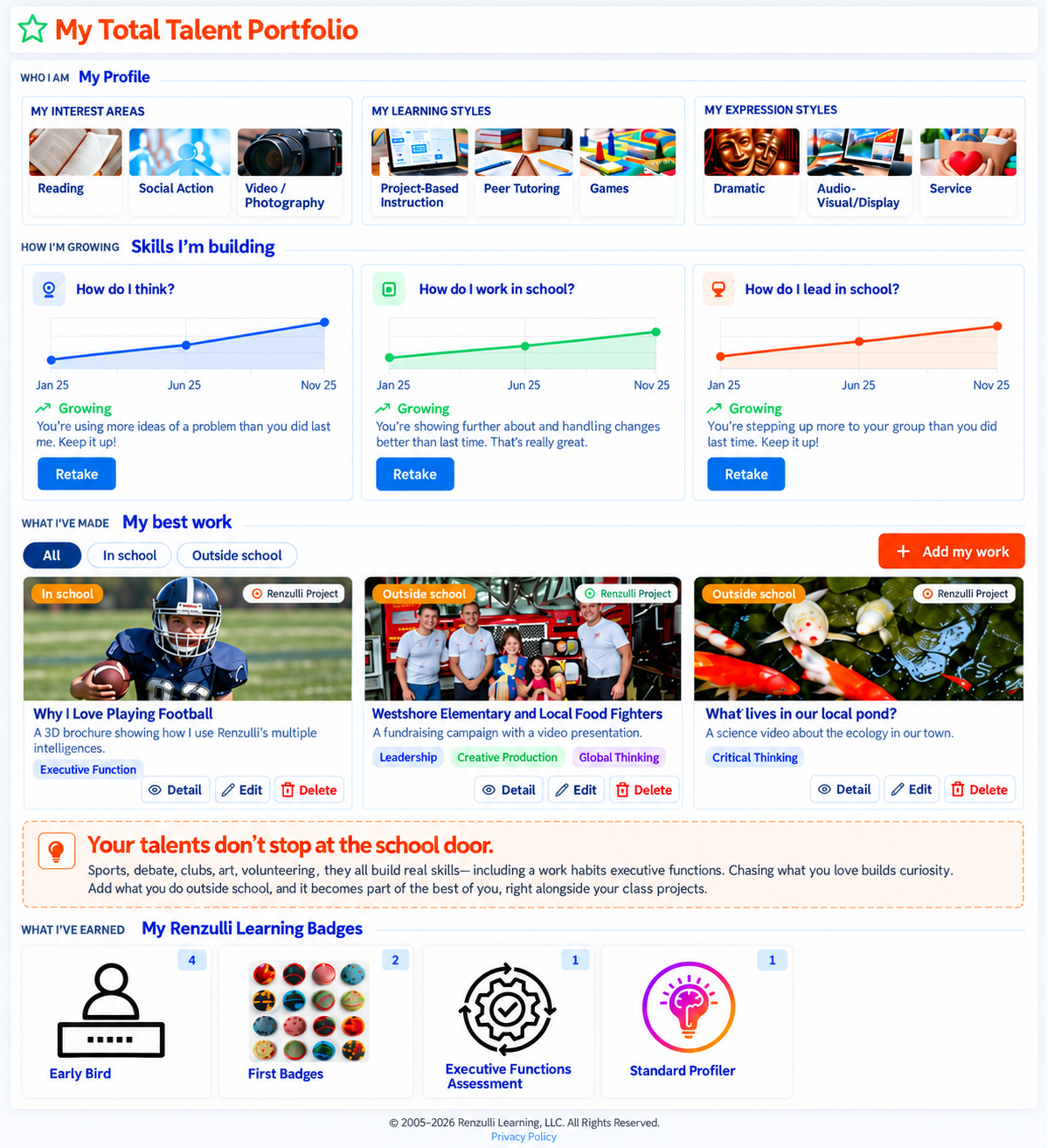
A foundational idea of the Schoolwide Enrichment Model, the Total Talent Portfolio was designed by Dr. Joseph Renzulli and Dr. Sally Reis on a simple premise: every student has strengths worth developing, and a record built around those strengths helps every educator who supports the student. Renzulli Learning brings that concept to life so the portfolio is never a form to fill in by hand, it is assembled from a student’s real profile data, measured skills, and authentic work.
It is the same portfolio for everyone who supports the student. It simply speaks to students in the language of strengths and growth, and to educators in the language of measurement.
Built to Get Students Off the Screen and Into Real Work
The Schoolwide Enrichment Model was designed to place student curiosity, not screen time, at the center of learning. Its Enrichment Triad moves students from exploring an interest, to building a skill, to becoming a first-hand investigator who creates an original product. That third step, the heart of the model, happens in the world: in labs, workshops, communities, teams, and studios, not in front of a monitor.
Renzulli Learning is where students plan, launch, and showcase that work. They use the platform briefly and purposefully, to find a project, set a goal, or present a finished product, and spend the bulk of their time doing. The result is a platform that helps reduce passive screen minutes while deepening engagement and building durable skills.
Three Parts, One Complete Picture
Every part of the Total Talent Portfolio connects to the student’s profile and their work, creating a complete picture that grows with them:
Interests & Learning Styles
Drawn from the Renzulli Profiler, the portfolio captures what a student loves, how they learn best, and how they like to express what they know, the foundation for personalized enrichment and authentic projects.
Durable-Skill Growth Over Time
Growth across the four assessments, the Critical Thinking Assessment, Executive Function Assessment, Leadership Assessment, and Cebeci Test of Creativity, recorded across multiple sittings so development is visible and reportable.
Best Work, In and Out of School
Showcased projects from the Project-Based Learning module, plus accomplishments students add from outside school, clubs, sports, community service, internships, and the arts, each tagged to the durable skills it evidences.
How Evidence Gets In
The portfolio fills with real work, and every entry is teacher-approved, so what appears is authentic and vetted.
Students upload their own evidence
From class projects to clubs, sports, and community service, students add the work that shows who they are, in and out of school.
Teachers can upload on a student’s behalf
So nothing important is missed, a teacher can add evidence directly to a student’s portfolio.
A teacher approves every upload
Nothing appears in the portfolio until a teacher reviews and approves it, keeping the record authentic and vetted.
Strengths for Students. Measurement for Educators.
The Total Talent Portfolio is a single record with two ways of reading it, so it speaks to each audience appropriately:
The Total Talent Portfolio Is Your Portrait of a Graduate Profile
A Portrait of a Graduate defines the durable competencies your community commits every student will develop. The Total Talent Portfolio measures those competencies, collects the evidence through showcased work, and shows growth over time, for every student:
| Durable Skill | What the Portfolio Documents | Where the Evidence Comes From |
|---|---|---|
| Critical Thinking | A student self-report of how often they use analysis, evaluation, inference, and reasoning, alongside projects that show evidence-based thinking. | Critical Thinking Assessment, showcased PBL work |
| Creativity | Original ideas and creative products over time, expressed through the student’s own work. | Cebeci Test of Creativity, PBL, enrichment products |
| Executive Function | Planning, organization, self-regulation, and follow-through, measured and shown as growth. | Executive Function Assessment, project milestones |
| Leadership | Collaboration, initiative, and influence, documented in school and through outside activities. | Leadership Assessment, service projects, outside accomplishments |
| Communication | Authentic presentation of finished work to real audiences. | Project Showcase, showcased outside work |
| Self-Direction | Student-chosen projects, interests pursued, and a body of work built over time. | Renzulli Profiler, PBL, Personal Success Plan |
| Whole Student | Interests, learning styles, and accomplishments from both inside and outside school, in one record. | The complete Total Talent Portfolio |
Where the Total Talent Portfolio Comes From
The Total Talent Portfolio is not a marketing idea, it is a documented component of the Schoolwide Enrichment Model, developed and researched by Dr. Joseph Renzulli and Dr. Sally Reis at the University of Connecticut over more than five decades. These peer-reviewed and university-published sources define the Total Talent Portfolio and its role:
The Foundational Paper
Renzulli, J. S. (1997). The Total Talent Portfolio: Looking at the best in every student. Gifted Education International, 12, 58–63.
SEM & the Three Components
Renzulli, J. S., & Reis, S. M. (2010). The Schoolwide Enrichment Model: A Focus on Student Strengths and Interests. Gifted Education International, 26(2&3), 140–156. Hosted by UConn.
Four Decades of SEM Research
A literature review of Schoolwide Enrichment Model research, including the role of the Total Talent Portfolio in identifying and developing student strengths and interests.
Indexed in ERIC
The Schoolwide Enrichment Model: A Focus on Student Strengths and Interests, indexed in the U.S. Department of Education’s Education Resources Information Center (ERIC).
Explore more at the Renzulli Learning research library and the Renzulli Center for Creativity, Gifted Education, and Talent Development at UConn.
The Total Talent Portfolio: Common Questions
What Feeds the Total Talent Portfolio
Research-Proven Results, Not Just Engagement
Independent, peer-reviewed studies of the Schoolwide Enrichment Model and Renzulli Learning show measurable gains for students:
Higher predicted future earnings for students in individualized enrichment built on Renzulli's model
University of Amsterdam · Booij, Haan & Plug (2016)
Creativity percentile gain after three years of Schoolwide Enrichment Model implementation
Italy SEM Study
Of underachieving students reversed underachievement through interest-based creative productivity
Baum, Renzulli & Hébert (1995)
Reading comprehension gains in a cluster-randomized study of Renzulli Learning across diverse schools
Field (2009), research on an earlier version
Call +1 (203) 680-8301 · Email [email protected]